Distant Sun
EARLY RETIREMENTMEMORIESTHAILANDMALAYSIA
R
1/27/20266 min read
Foreword
What, you may be wondering (or not…), was the inspiration for yet another Superman blog? No, it's not nerdery, delusions of grandeur, or even heat stroke melting my brain in KL. Once again, it was having the time to appreciate the views from a couple of thirtieth-floor apartments in Bangkok and Kuala Lumpur and let my mind wander.
This time, my firing synapses prompted me to reflect on my early retirement a year on - not just the cessation of research and work, but the deliberate act of letting go of identity, obligation, and the ‘comfort’ of being needed. My brain, with its creative flair, added Crowded House’s 1993 hit “Distant Sun” as its soundtrack (have a listen and enjoy before reading).
What follows, then, is less a meditation on Superman than it is an exploration of distance, perspective, and the uneasy freedom that comes with choosing to step away. Superman simply happened to be the figure capable of carrying that weight.
R.
---
Tell me all the things you would change,
I don't pretend to know what you want
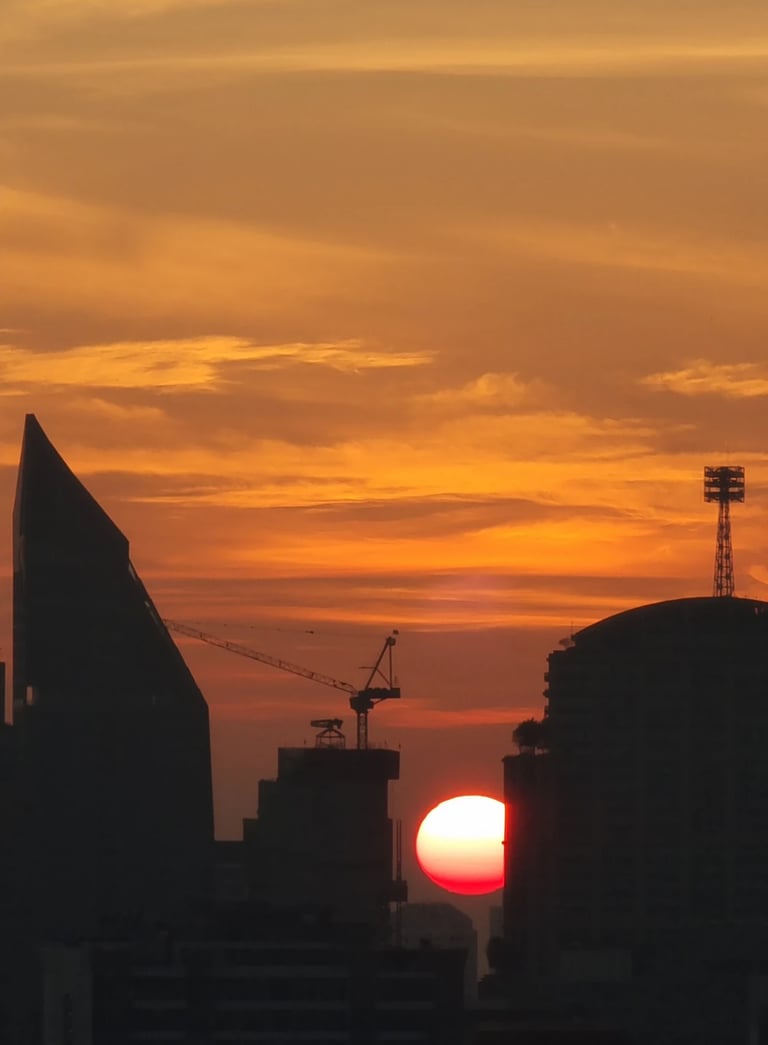
The early morning beauty of this red sun blessing presents another perfect opportunity and invitation to take time to pause and reflect. Yet another orbit around Sol completes, and what has changed for Clark? Well, here he sits again on another balcony, on a welcome break, distant from all of the madness that tries to infest, erode, and corrupt. A withdrawal that allows the grind and grime from this daily planet to be put aside for some other day. This has clarified him. In the absence of obligation, contemplation has taken its place. He no longer measures his utility and worth by arbitrary titles and chasing metrics but by what he chooses to share - small courtesies, unremarkable kindnesses, the patience to learn rather than to fix. The respite is a lesson as much as it is relief.
No fire where I lit my spark
After so many years of answering expectations and pouring his strength into what was demanded of him, this past year of freedom clarified what had quietly been reshaping itself all along: his priorities, once assumed to be fixed, had realigned. Now, in the quiet, there is room for something else, for the world endures, and he, for the first time in a long while, learns to be satisfied with being part of that motion rather than its axis.
Gone is the reflex to intervene. Here, under an indifferent sky and a generous sun, he allows the day to remain unclaimed. Whatever comes next can wait. For now, it is enough to sit, to breathe, and to learn who Clark is when the world is not asking him to save it.
Old enough to know who you are
Wise enough to carry the scars
There was the Justice League. “Come out to the coast. We’ll get together, have a few laughs.” The words returned now stripped of warmth, sounding less like an invitation than a relic - something said back when his presence still mattered. He tried to be fair about it. Fairness had always mattered to him: measured judgment, charitable interpretation, the discipline of crediting effort even when results fell short. But distance sharpened comparison, and comparison stripped away comfort.
They were coping. That much was undeniable. The Justice League still convened, still able to hold the line often enough that the(ir) world endured. He told himself he was glad they were managing. Most days, he even meant it. Still, the thought carried an edge he did not entirely smooth away: managing was all they were doing.
Bruce (Batman) solved problems the way Bruce solved everything by overwhelming them with resources. Money became momentum; momentum masqueraded as progress. Facilities were built, technologies deployed, and crises deferred rather than resolved. It worked, in the narrow sense. Some immediate fires went out. But Clark could see the pattern even from a distance: nothing stayed fixed for long.
And then there was Diana (Wonder Woman).
He had always admired her certainty—the way she spoke of truth as if it were a fixed point rather than a negotiation. In the field, it was reassuring. On the battlefield, it was formidable. Clark sometimes imagined, with a wryness that surprised him, what would happen if someone casually draped her Lasso of Truth across the conference table and suggested they all take a turn, starting with her. Not theatrically. Not as an accusation. Just a gentle procedural enhancement. Before we adjourn, Diana, perhaps the unvarnished version? He suspected the room would go very quiet.
As for Barry (The Flash). He tried, honestly tried not to think it. It felt uncharitable, unkind, the sort of judgment he had spent a lifetime correcting in himself. But honesty, once allowed in, tended not to respect manners. Barry was a fucking idiot. Every mistake was treated as an anomaly rather than a pattern. Every disaster came with a smile and a promise to do better next time, as though charm were a form of accountability.
The League, collectively, had become adept at this - substituting process for outcome, symbolism for resolution. Meetings ended with action items instead of answers. Success was defined by survival metrics rather than by the solutions themselves. They congratulated themselves on restraint, on proportionality, on realism. Clark heard those words now and felt only fatigue. For Clark, revisiting that past was like exposure to kryptonite for the mind, each memory draining him in ways nothing else could. ENOUGH!
And dust from a distant sun
Will shower over everyone
Something once bright, once central, now reduced to residue, is still present, still capable of touching everything, but should no longer shape his orbit.
That is how the Justice League begins to feel when he allows himself to think of it properly. Not erased, not denied, but receding. A star he once revolved around, whose gravity defined his days, now far enough away that its influence arrives only as fallout - memory, habit, reflex. The dust settles evenly, without judgment. It does not demand action. It does not call him back. But it does…
The past does not vanish; it diffuses. The League, the meetings, the compromises, the weight of always finding the answer - these are no longer forces pulling him forward or back. They are particles, drifting, harmless unless he chooses to gather them again.
What he wants, he realises, is not reconciliation or closure in any formal sense. It is freedom from proximity. To let what once burned so intensely become distant enough that it can only illuminate, not consume. Please. A faded memory that is not a failure of loyalty but the natural end state of something that once demanded too much.
And in that settling dust, there is hope. Not the grand, declarative kind he used to represent, but something quieter and more durable. If the past can disperse without disappearing, then the future does not need to be built in opposition to it. He can move forward without carrying the League as a constant reference point, without being defined by what he was to them, or they to him. Let that distant sun remain distant, and finally step into a life that does not require him to orbit anything at all.
I don’t pretend to know what you want
But I offer love
Distance is needed. High on this thirtieth-floor balcony, Clark feels a distance immediately—here he finds a clean, impersonal detachment that settles in without asking permission. But he finds himself mourning what is missing: the grounded intimacy he felt last year on a lower balcony in Chiang Mai, where the city had pressed closer, and life had retained its texture. The contrast draws his thoughts to the accounts he has read from astronauts, of the so-called Overview Effect, and how perspective shifts not only what one sees, but what one feels allowed to matter. Their revelation in orbit when the moment Earth is seen whole, borderless, fragile, suspended in silence, all divisions dissolve. Conflict looks trivial. Humanity becomes a single, shared enterprise.
The thirtieth floor produced a faint echo of that effect.
From there, the city simplified, reducing itself to patterns. Boundaries blur. Individual urgency gives way to collective motion. People become evidence of a functioning system rather than lives unfolding in real time.
The nineteenth-floor balcony in Chiang Mai told a different story.
There, the city revealed its edges. Faces were not interchangeable. Gestures were legible: friends greeting each other, a laugh shared loudly, a momentary hesitation before stepping into traffic. He could hear fragments of life: voices, engines, the uneven rhythm of human movement. The world wasn’t behaving like a model system but a collection of individual decisions.
Clark watches and feels the distance settle - not as isolation, but as perspective. He is not above them in any meaningful sense. He is simply apart. He is a distant son, not withdrawn, not disconnected, but no longer defined by constant proximity. The past, with all its weight and expectation, loosens its hold. What remains is the possibility of a quieter presence, one that gives without dominating and belongs without burden.
The city continues below him, complete in its own right. Clark exhales, accepting that he does not need to know what it wants in order to care about it. That realisation, more than any power he has ever possessed, feels like the beginning of something liberating, something sustainable.
Copyright © 2024 by Two Go Travelling. All rights reserved.
Copyright © 2025 by QuietKaizen. All rights reserved.